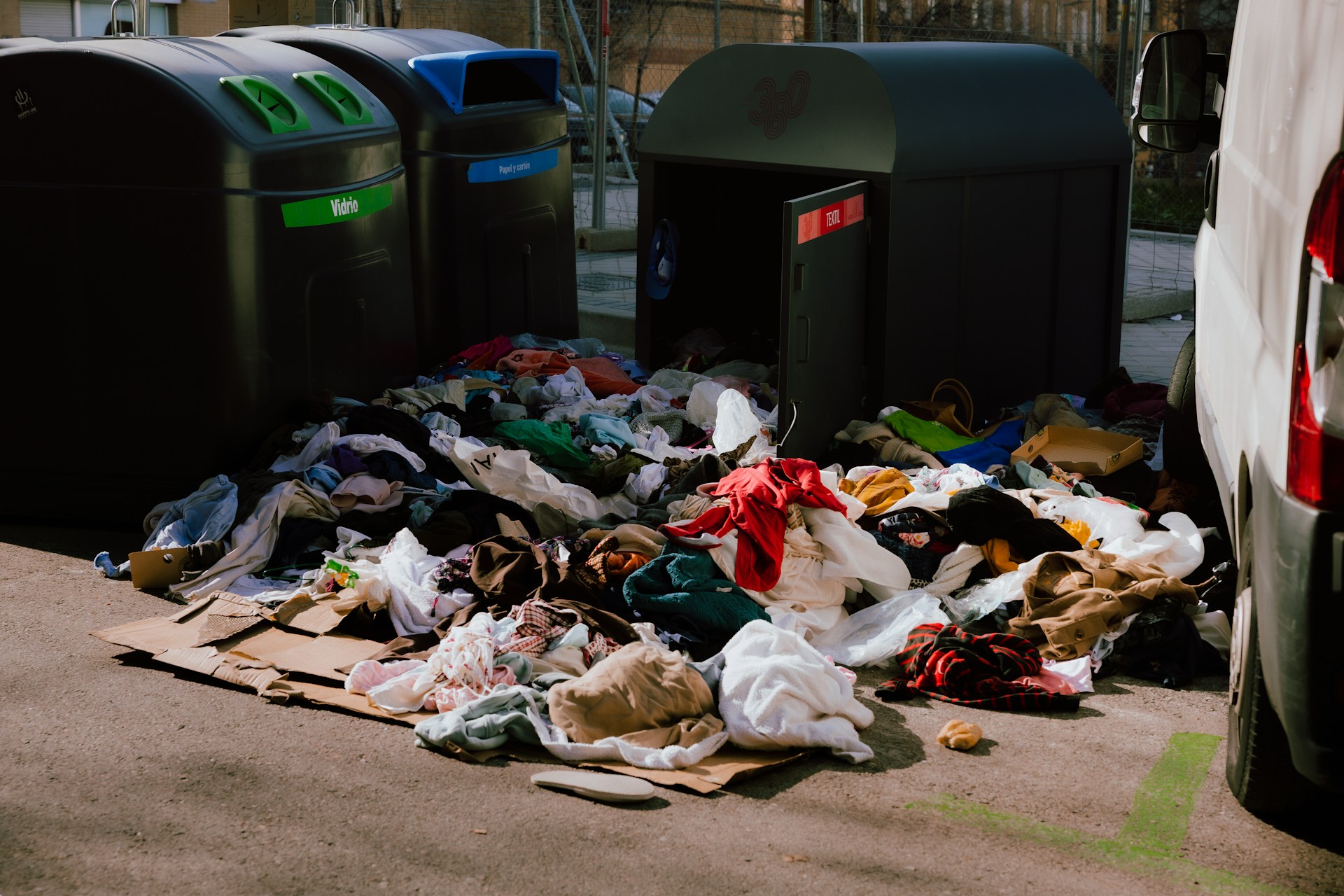
We all know fast fashion is "bad." But how bad? Like, really? Because when you're standing in Primark holding a £4 top, it's easy to shrug and think it's just a shirt.
It's not just a shirt.
What you're holding is the end product of one of the most environmentally destructive industrial processes on Earth — a journey that began with oil rigs, chemical vats, and factories pumping poison into rivers, and will likely end in a landfill where it will sit, largely intact, for the next two centuries.
Let's trace that journey from the very beginning. Because once you see it, you can't unsee it.
Part One: Where Does a Synthetic Garment Actually Come From?
The majority of clothes sold today — roughly 60% of all garments globally — are made from synthetic fibres. Polyester is the most common, followed by nylon, acrylic, and spandex. These aren't plant-based materials. They aren't animal-based. They are, quite literally, plastic — derived from crude oil and fossil fuels.
Step 1: The Oil Rig
Your polyester t-shirt's story begins underground, often beneath the seabed. Crude oil is extracted via drilling — a process that burns enormous amounts of energy and releases methane, a greenhouse gas that is around 80 times more potent than CO₂ over a 20-year period, directly into the atmosphere. Even before your shirt exists, the planet has already taken a hit.
The fashion industry requires 70 million barrels of oil every single year just to produce polyester fibres. That figure doesn't include nylon, acrylic, or any other synthetics. Just polyester.
Step 2: The Chemical Plant
Crude oil is refined into a chemical called ethylene, which is then processed into a polymer called polyethylene terephthalate — better known as PET. This is the same material used to make plastic bottles. It's spun into fibres, and those fibres are woven into the fabric we wear against our skin.
The process is extraordinarily energy-intensive. Manufacturing one kilogram of polyester fabric generates around 9.52 kg of CO₂. A single polyester t-shirt carries a carbon footprint of approximately 5.5 kg of CO₂ equivalent — more than two and a half times the footprint of a cotton shirt (2.1 kg).
Step 3: The Dye Factory
Fabric needs colour. The dyeing and finishing processes are among the most chemically toxic stages of garment production. Textile dyeing is responsible for roughly 20% of all industrial wastewater pollution globally. The leftover water — laced with heavy metals, acids, and synthetic dyes — is routinely dumped into local waterways in countries with lax environmental regulation.
Dhaka, Bangladesh — one of the world's biggest garment manufacturing hubs — became infamous for rivers running black and blue and red from dye effluent. Entire communities downstream suffer from skin diseases, respiratory problems, and contaminated drinking water so that someone can buy a £6 blouse.
Step 4: The Factory Floor
Once the fabric is dyed, it's cut and sewn — usually in factories in Bangladesh, Cambodia, Vietnam, or China, where labour is cheap. The garment then travels thousands of miles by container ship to reach a distribution centre in the UK, adding yet more emissions to the tally.
By the time your £8 polyester dress hits the rail, it has crossed oceans, consumed fossil fuels, generated toxic waste, and poisoned rivers.
Part Two: The Numbers That Should Horrify You
Let's put some hard numbers on the scale of this problem.
- Global fibre production has nearly doubled in the last 20 years, from 58 million tonnes in 2000 to 116 million tonnes in 2022, and is projected to hit 147 million tonnes by 2030.
- The fashion industry is responsible for 8–10% of global carbon emissions — more than all international flights and maritime shipping combined.
- Without change, the industry is on track to consume a quarter of the world's entire carbon budget by 2050.
- Every second, the equivalent of a full rubbish truck of textiles is either landfilled or incinerated. By the time you finish reading this article, hundreds of truckloads will have been disposed of.
- Around 92 million tonnes of textiles end up in landfill globally each year.
These aren't slow, abstract, long-term statistics. This is happening right now, at an industrial scale, every single day.
Part Three: The Washing Machine Problem Nobody Talks About
Here's the bit that really should make you stop and think.
You've bought your polyester shirt. You've already contributed to the emissions, the oil extraction, the river pollution. But the garment doesn't stop damaging the planet once it's in your wardrobe. Every single time you wash it, it sheds plastic into the water supply.
When synthetic fabrics go through a washing machine, microscopic plastic threads — called microfibres or microplastics — break off and pass through your drain. They are so tiny that most wastewater treatment plants cannot capture them. They flow through to rivers, then to the sea.
A single wash load can release between 700,000 and 1.5 million microplastic fibres. Every. Single. Wash.
Synthetic textiles are now the source of around 35% of all microplastic pollution in the world's oceans. Scientists estimate there are currently 51 trillion microplastic particles in our seas. They've been found in the deepest ocean trenches, in Arctic ice, in the gut of fish, in shellfish we eat, in drinking water, in human blood, and — most disturbingly of all — in human placentas and breast milk.
We are literally eating, drinking, and breathing our clothes.
Part Four: The End of the Road — Or Rather, the Beginning of 200 More Years
So what happens when your synthetic garment finally wears out, or falls victim to a trend cycle that's moved on?
Most likely, it ends up in landfill. Around 85% of textiles globally are either landfilled or incinerated each year. And here's where the timeline becomes truly sobering.
How Long Does Synthetic Clothing Actually Take to Decompose?
| Fabric | Time to Decompose |
|---|---|
| Linen | 2 weeks |
| Cotton | A few months |
| Wool | 1–5 years |
| Nylon | 30–40+ years |
| Polyester | 200–500 years |
| Acrylic / Spandex | 200+ years |
Your polyester t-shirt — the one that might have been worn a dozen times before you moved on — will be in that landfill long after every person alive today is dead. Your great-great-great-great-grandchildren's grandchildren may still share the planet with that shirt.
And while it sits there, it doesn't just sit quietly. As synthetic fabrics slowly break down in landfill conditions, they continue releasing microplastics into the surrounding soil and groundwater. They also release greenhouse gases as they slowly degrade, contributing further to climate change. Incinerated garments release toxic chemicals into the air.
There is no clean ending for a synthetic garment. Not ever.
Part Five: What About Natural Fibres?
Natural fibres — cotton, wool, linen, hemp, silk — come with their own complexities, but they are fundamentally different in one critical way: they can return to the earth.
A 100% cotton t-shirt can biodegrade in a matter of months. Pure linen can break down in as little as two weeks. Wool, in soil conditions, typically takes one to five years. These materials are made of cellulose or protein — substances that bacteria and fungi have been breaking down for millions of years. When they reach the end of their life, the cycle closes.
Natural fibres also don't shed microplastics when washed. They may release fibres, but those fibres biodegrade rather than accumulating as permanent plastic pollution.
The carbon footprints of natural fibres vary — growing cotton is water-intensive, and wool has associated methane emissions from sheep — but neither comes close to the cradle-to-grave destructiveness of polyester. Crucially, the end-of-life problem is solved. A cotton shirt returns to nature. A polyester shirt never really does.
The ideal? Well-made natural fibre garments, worn for a long time, by as many people as possible. Which brings us to the single most powerful thing any of us can do.
Part Six: Why Swapping Clothes Is One of the Most Effective Environmental Actions You Can Take
The most significant variable in any garment's environmental impact is how many times it is worn.
Research consistently shows that extending the life of a garment by just nine additional months reduces its carbon, water, and waste footprint by around 20–30%. The maths isn't complicated: the environmental cost of making a garment is fixed. The more you spread that cost across wears — or across multiple owners — the lower the impact per use.
Swapping clothes is the most direct way to put this into practice at scale.
When you swap a garment on Swapster rather than buying new, you are:
Preventing a new garment from being manufactured. Every swap is a new purchase that didn't happen. No oil extraction. No chemical plant. No dye factory. No container ship. The emissions, the water use, the toxic effluent — none of it occurs, because the garment that satisfies your need already exists.
Keeping a garment in use rather than in landfill. The item you're swapping away doesn't end up in a bin bag. It goes to someone who wants it, extending its life by months or years.
Choosing natural fibres that actually return to earth. When you swap vintage and pre-loved natural fibre clothing, you're participating in a genuinely circular system. Cotton, wool, linen — these can eventually biodegrade. Swapping them instead of discarding them delays even that.
Sending a market signal. Every swap over a new purchase chips away at the economic model that makes fast fashion possible. Industry responds to consumer behaviour. The more of us who swap, the less demand exists for throwaway polyester.
The Bigger Picture: Stop Making the Stuff
Swapping is powerful, but we should be clear-eyed about what we're ultimately working towards. The goal isn't just to manage the enormous volume of synthetic clothing that already exists — it's to stop producing so much of it in the first place.
The fashion industry has spent decades lobbying hard against regulation and leaning on recycling as a fig leaf. Currently, less than 1% of textile waste is recycled into new clothing. And "recycled polyester," often promoted as an eco win, may actually shed even more microplastics than virgin polyester.
The real solutions are structural: fewer garments produced, of better quality, from natural or genuinely biodegradable materials, designed to last and to be shared. Swapping — especially swapping natural fibre clothes — is the individual action that maps most directly onto that vision.
When you use Swapster, you're not just refreshing your wardrobe. You're refusing to add to a system that is pumping plastic into our oceans, pouring poison into rivers, and committing future generations to a planet stained with our throwaway culture.
So, What Can You Do Today?
- Check your labels. If it says polyester, nylon, acrylic, or elastane — it's plastic. Wear it longer, wash it less, and replace it with natural fibres when you can.
- Swap before you shop. Swapster.co.uk lets you trade clothes you no longer wear for things you actually want. No money changes hands. No new garment gets made.
- Choose natural fibres when buying new. Cotton (ideally organic), linen, wool, and hemp are all biodegradable. They're also, generally, more comfortable, more durable, and better for your skin.
- Wash synthetic clothes less and colder. Every wash releases microplastics. Lower temperatures and shorter cycles release fewer fibres.
- Talk about it. Most people genuinely don't know their gym leggings are shedding plastic into the ocean every wash. Awareness is where change starts.
The garment industry wants you to think that sustainability is complicated — that it requires specialist knowledge and expensive ethical purchases. It doesn't. The most sustainable garment is one that already exists, being worn by someone who loves it.
That's what Swapster is for.
Start swapping at swapster.co.uk →
Sources: Geneva Environment Network, United Nations Environment Programme, Ellen MacArthur Foundation, International Union for Conservation of Nature, Earth.org, World Resources Institute, University of Plymouth Marine Science, Textile Exchange, Nature (Scientific Reports).
Photo by Deniz Demirci on Unsplash
