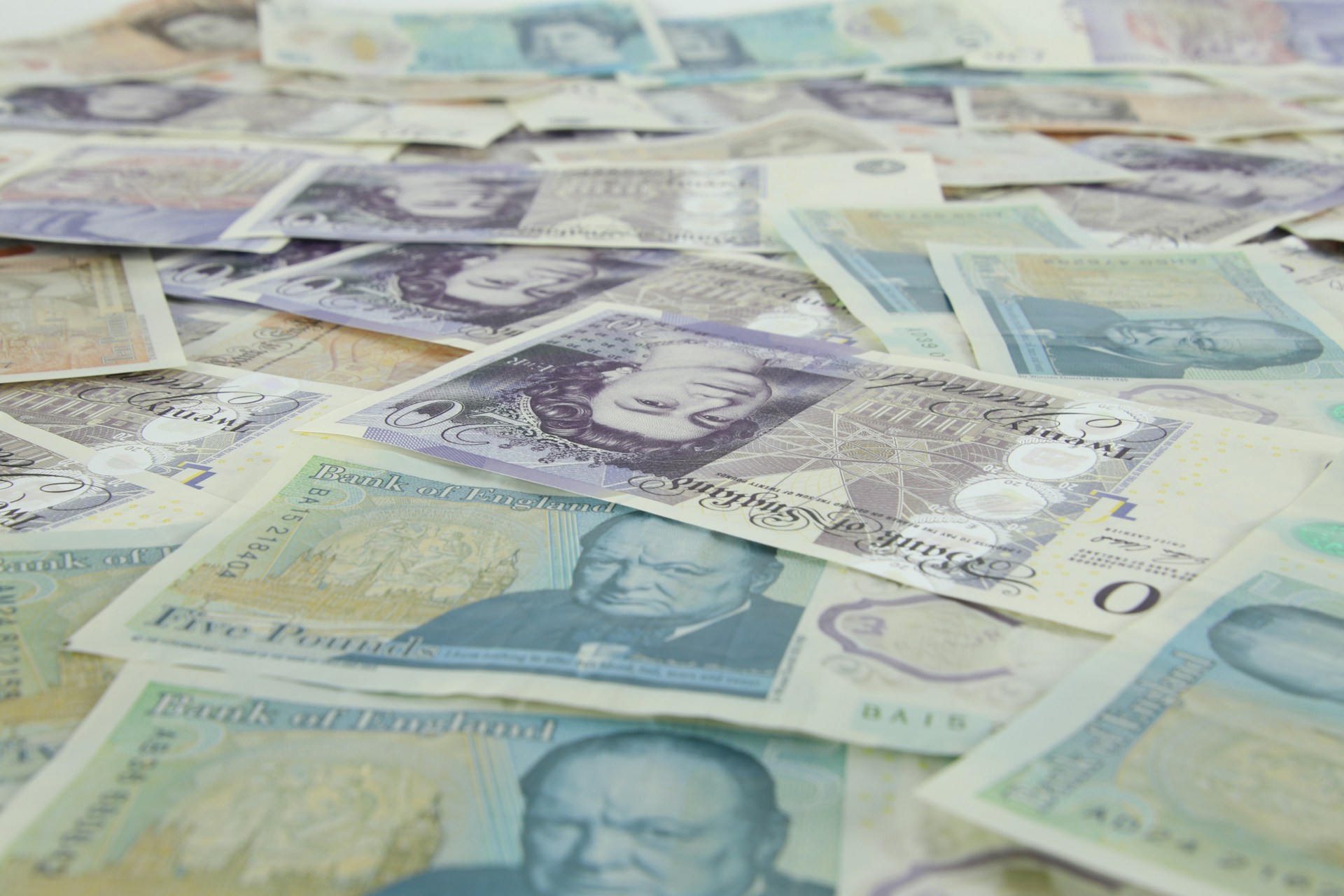
Everything costs more than it used to. The weekly shop, the tank of fuel, the pint, the rent. We call it "inflation" and mostly shrug, as if it were weather — something that happens to us rather than something done by anyone in particular.
But a price increase isn't weather. Every higher price is set by a person or a business, and each of them is reacting to someone in front of them in the queue. So it's worth asking a simple question: if you follow the chain of price rises backwards, who's standing at the very front, raising their price with nobody ahead of them to blame?
That question takes us somewhere interesting — and it lands surprisingly close to what Swapster is about. Let's walk it through in plain terms.
What inflation actually is
Inflation is just the general rise in prices across an economy over time — or, said the other way around, the fall in what a single unit of money can buy. If a loaf cost £1 last year and £1.10 now, the loaf hasn't become more nutritious. Your pound has become weaker.
That framing matters, because it splits the conversation in two. Either things are genuinely getting harder to produce, or money is getting less valuable. Most of the time, it's a mix of both, and untangling them is the whole game.
The price chain: who passes the parcel?
Picture a loaf of bread arriving on a shelf. Trace its price backwards.
The supermarket raised its price because the bakery charged more. The bakery charged more because flour got dearer, and because wages, electricity and rent all went up. The mill charged more because wheat got dearer and because diesel for transport rose. The farmer charged more because fertiliser, fuel, seed, machinery and labour all cost more. The fertiliser producer charged more because natural gas — its main input — spiked. And so on.
Every link in that chain is doing the same thing: someone in front of them raised a price, so they raised theirs to protect their margin. It's a game of pass-the-parcel, and the parcel is "higher cost." Nobody in the chain feels like the villain. Each is simply responding to the link ahead.
This is the part most people intuitively understand. Costs ripple downstream, and we — the shoppers at the very end of the chain — catch the parcel last, with no one to pass it to. We just pay.
But it raises the obvious follow-up: keep walking up the chain, past the farmer, past the gas producer. Is there a front of the queue? Is there someone raising a price with no increase in front of them?
Two different stories about the front of the queue
Here's where honesty matters, because there are two genuine explanations and they're often blended together — sometimes deliberately.
Story one: real scarcity. Sometimes the front of the queue is the physical world. A war disrupts gas supply. A drought wrecks a harvest. A pandemic snarls shipping. A key mine floods. In these cases the first price rise is real — a genuine shortage of a genuinely useful thing. The cost is passed down the chain because the underlying scarcity is true. This is inflation with a cause you can point at. It's painful, but it isn't "made up."
Scarcity is worth pausing on, because it's the most honest force in the whole story — and the one you can actually see working. It isn't only about higher input costs grinding down the chain. It's about us. When there are only a few of something to go around, people naturally pay a little more to make sure they're the one who gets it. Nobody is being tricked; everyone is simply behaving sensibly. You'd rather pay an extra fiver and secure the thing than save the fiver and miss out. Multiply that instinct across thousands of buyers all eyeing the same small pile, and the price drifts up on its own — no central bank required.
Think of the last hard-to-find concert ticket, a limited sneaker drop, a rare trading card, the one flat left in a good area. The item didn't change. What changed is that demand outran supply, and our shared willingness to pay a bit more to not miss out did the rest. That's scarcity setting a price honestly: value decided by how much people actually want a thing relative to how little of it exists.
This is exactly what Swapster's Market Exchange Value (MXV) measures — and it does it in the most honest way possible: by counting. MXV looks at how many of an item are actually available on the sell side, against how many people have listed that same item on the ask (buy) side of a swap. It's supply and demand, taken literally.
Say there's one bag of potatoes available to swap, but five people have a bag of potatoes listed as their ask. That's five wanting, one going. The MXV climbs, because the numbers themselves say the item is scarce and sought-after. Flip it — fifty bags available and one person asking — and the MXV settles down, because supply now dwarfs demand. No number handed down from above, no guesswork: just a live read on how few are left versus how many hands are up.
That's scarcity doing its honest work, out in the open where you can see it. It's the same ancient mechanic that has always set prices in a real market — the meeting point of "how badly do people want this" and "how little of it exists" — except on Swapster it's measured transparently rather than buried inside a supply chain or a money supply. You can read more about how MXV is calculated at swapster.co.uk/exchange-value.
Story two: more money chasing the same goods. The other story is monetary. If the amount of money in the economy grows faster than the amount of stuff to buy, then prices rise even when nothing physical has changed. There's no drought, no war, no shortage — just more pounds (or dollars) competing for the same loaves. Each unit of money buys a little less, so every price drifts upward.
So is the front-of-the-queue price increase "made up"? Sometimes, in a sense, yes — not invented out of malice, but created when new money is added rather than new goods. And that brings us to the genuinely uncomfortable part.
Where new money comes from — and who touches it first
Modern money is fiat: it isn't backed by gold or anything physical. It has value because a government decrees it legal tender and because we all agree to accept it. That agreement is the whole foundation. A £20 note is worth £20 because everyone in the chain above believes the next person will take it.
New money enters the system in two main ways. Central banks create it (historically by "printing," more often now by crediting accounts and buying assets), and commercial banks create it when they lend — most of the money in circulation is conjured into existence as loans, not minted as coins.
The scale isn't trivial. In the United States, a frequently cited figure is that roughly a quarter of all the dollars that have ever existed were created in just a couple of years around 2020. Whatever the exact number, the direction is not in dispute: the money supply has expanded enormously, and far faster than the supply of actual goods.
Now, the crucial bit. That new money does not land on everyone's doormat at the same moment. It enters at specific points — banks, financial institutions, governments and the large players closest to the tap. They get to spend it first, while prices are still at yesterday's levels. By the time it has trickled through the economy and reached ordinary wages, prices have already risen to absorb it.
Economists have a name for this: the Cantillon effect, after an 18th-century writer who spotted it. The people first in line for new money gain real purchasing power. The people last in line — wage earners, savers, pensioners — find that prices rose before their incomes did. They're holding the parcel.
So when we may ask whether someone is at the front of the price chain with no increase in front of them, this is the honest answer. The front of the queue isn't only droughts and wars. It's also the point where new money is created and the people who get to use it before it loses value. That is a real, structural advantage, and it largely explains why inflation quietly transfers wealth from the many to the few.
Is the fiat system fair?
The case that it's broadly fine. Fiat money, managed well, is flexible. A central bank can soften a recession, respond to a crisis, and avoid the brutal boom-and-bust cycles that plagued economies tied rigidly to gold. Mild, predictable inflation even has defenders: it nudges people to invest rather than hoard, and it makes debts easier to manage. Most mainstream economists would say the problem isn't fiat itself but fiat abused — money created faster than it should be. On this view the system is a powerful tool that occasionally gets misused, not a rigged game.
The case that it's unfair by design. The other view says the unfairness is baked in, not incidental. Whoever controls money creation, and whoever sits closest to the tap, holds a permanent structural edge. Savers are quietly taxed by inflation without a vote. Asset owners get richer as new money inflates the price of houses and shares, while renters and wage earners fall behind. And the whole thing rests on trust that can be — and historically has been — debased. From this angle, inflation isn't a bug or bad weather. It's a transfer, and it always flows in roughly the same direction.
Both cases contain real truth, and reasonable people land in different places. What's hard to deny is the mechanism: in a fiat system, who gets the money first matters enormously, and it usually isn't you.
Before all this, there was swapping
Step right back, past money entirely, and you reach how humans traded for most of our history: directly. I have grain, you have fish, we swap. I fix your roof, you teach my kid. Value moved from hand to hand based on what two people actually agreed something was worth, in the moment, to them.
Barter had a famous weakness — the "double coincidence of wants." For a swap to work, I have to want what you have and you have to want what I have, at the same time. Find someone selling exactly what you need who also happens to want exactly what you're offering, and you've struck gold. Most of the time you don't, and the deal dies. Money was invented largely to solve that. It's a universal placeholder for value, so you never have to find a perfect match. That was a genuine leap forward, and it's worth giving money its due.
But here's the thing: that weakness was a limitation of direct, one-to-one barter — two people, one swap. It's not a law of nature. And it's exactly the problem Swapster's chain swapping is built to solve. You no longer need the person who has what you want to also want what you have. Swapster links swaps together into a chain.
Picture it. User A has apples and wants oranges. User B has oranges and wants bananas. User C has bananas and wants apples. Under old-school barter, none of these three can trade — A and B aren't a match, B and C aren't a match, no single pair lines up. But arrange them in a loop and everyone's happy at once: A's apples go to C, C's bananas go to B, B's oranges go to A. Three people, three wants met, zero money involved. The chain closes the loop that a single swap never could.
Economists and matching theory call this kind of closed loop a trading cycle (the algorithms that find them have names like "top trading cycles"), but you don't need the jargon to feel why it matters. Money solved the double coincidence of wants by inserting a middleman placeholder that everyone has to chase — and, as we've seen, that placeholder can be created, expanded and front-run by whoever sits closest to it. Chain swapping solves the same problem a different way: instead of routing everyone through money, it routes wants directly to each other. The matching is the magic, not the money.
But notice what we traded away in the bargain. The moment value runs through a single unit that someone else can create, expand and meter out, you've handed a lever to whoever sits closest to it. Direct swapping has no Cantillon effect. There's no front of the queue, because no one is creating new "swap units" out of thin air. The value is in the goods and the agreement, full stop. Two people decide what a fair trade is, and that's the price — no hidden erosion, no first-in-line advantage, no parcel quietly passed down to whoever's holding cash.
What's changed, and who benefits
So what changed between then and now? We gained enormous convenience and lost a little sovereignty over value. Money made trade frictionless and global — a real gift. But it also inserted a layer between people, a layer that can be expanded by those who control it, with the gains flowing first to whoever is nearest the source and the costs settling, last, on everyone else.
That's not a reason to romanticise barter or pretend we can run a modern economy on swapping fish for roof repairs. It's a reason to notice that swapping still has one quiet advantage money never fully replaced: value goes straight from one person to another, at a price they agree, with nobody skimming the difference through inflation.
That's the gap Swapster lives in. Every time you swap something directly — a skill, an item, an hour of your time — for something of equivalent value to you, you're trading the way humans did before any of this machinery existed. You're setting the price yourself, with the person across from you, in the present. No queue. No parcel. No quiet erosion between the moment you earned value and the moment you spent it.
You don't have to opt out of money to reclaim a bit of that. You just have to remember that it's still an option — and that every swap is one trade the Cantillon effect never gets to touch.
The short version
Prices rise link by link down a long chain, and we stand at the end of it. Some of those rises are real — true scarcity, honestly passed along. But a large share traces back to money itself being created faster than goods, with the first users of that new money quietly gaining at the expense of everyone further down the line. Fiat is convenient and flexible, and you can argue in good faith that it's a fine system well-managed — but it's hard to deny that it tilts the field toward whoever's closest to the tap.
Swapping was how we did it first, and it still does one thing money can't: it lets two people agree on value directly, with nothing skimmed in between. Worth remembering, next time you wonder why everything costs more — and who, exactly, that's working out well for.
Want to trade value directly, the way it was always meant to work? That's what Swapster is for.
Photo by Christopher Bill on Unsplash
